


Our Trains
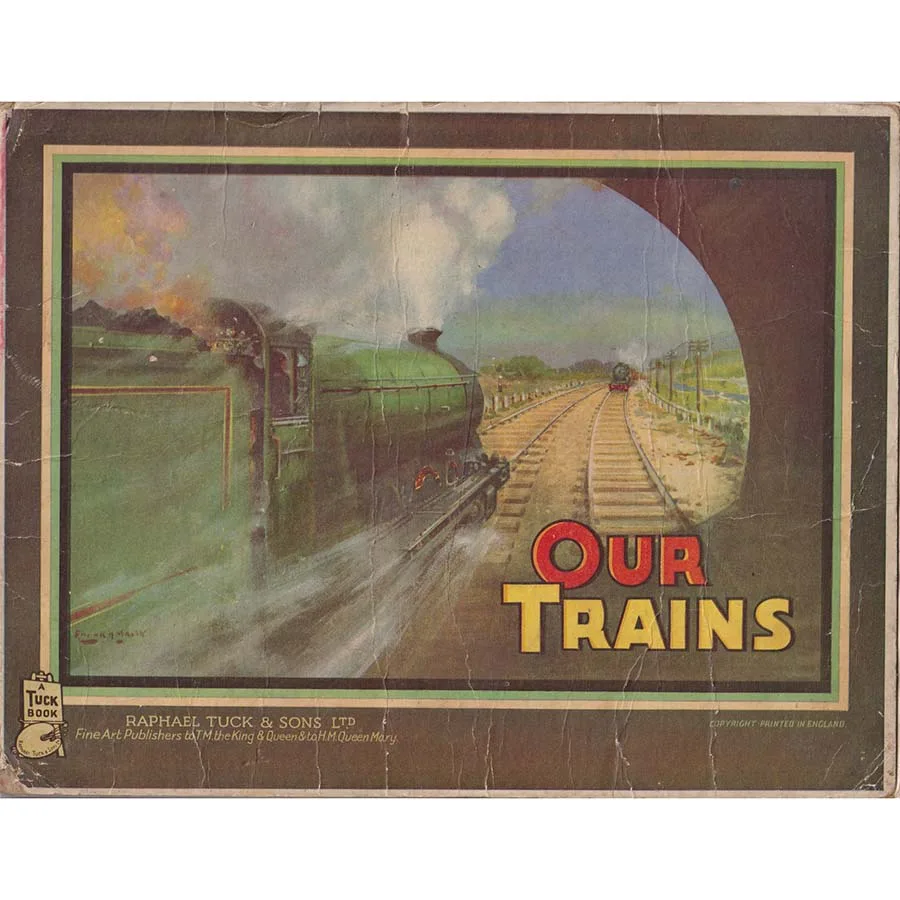
Publisher: Rapael Tuck and Son
Format: Paperback
ISBN: none
Our Trains (1940) by Frank H. Mason. Raphael Tuck & Son. ISBN: None. Condition: Good. Featuring 20 pages of beautifully illustrated trains.
There is something wonderfully reassuring about trains. They have an admirable habit of following rails that have been thoughtfully laid out in advance, announcing precisely where they intend to go, and generally arriving there without feeling the need to "disrupt the industry" or "pivot into AI."
Our Trains comes from a time when the railway was not merely a means of transport but a source of national pride. Published in 1940, at one of the most uncertain moments in British history, this charming little volume celebrates the locomotives that stitched together towns, cities and villages with clouds of steam, polished brass and an unwavering belief that punctuality was, at least in theory, achievable.
Frank H. Mason was one of Britain’s finest transport artists, and it quickly becomes apparent why. His illustrations capture not only the machinery itself but something of the romance surrounding it. These are not simply engines hauling carriages. They are great mechanical personalities, each appearing ready to thunder across the countryside with enormous confidence while scattering a respectable quantity of soot over anyone standing too close to the platform.
The book consists of twenty pages of wonderfully detailed train illustrations, each one reflecting an era when engineering was expected to be both practical and handsome. There is an elegance to these locomotives that modern transport rarely attempts. Today’s trains are undeniably faster, quieter and equipped with Wi-Fi that sometimes works. But very few inspire children to stand at level crossings waving enthusiastically, hoping the driver might answer with a blast of the whistle.
One of the unexpected pleasures of vintage railway books is discovering just how much affection they inspire in otherwise perfectly rational adults. Mention a steam locomotive at a dinner party and someone will inevitably begin reminiscing about summer holidays, station buffets, enamel signs or an uncle who insisted every locomotive could be identified instantly by the sound of its exhaust beat. Railway enthusiasm is one of Britain’s more endearing lifelong conditions.
Reading Our Trains also provides a fascinating glimpse into 1940 itself. While the world outside was changing dramatically, this little book quietly celebrated the machines that kept Britain moving. Railways carried soldiers, supplies, families and hope across the country, making books like this more than simple collections of pictures. They became small celebrations of engineering, resilience and everyday life continuing despite extraordinary circumstances.
As with many Raphael Tuck publications, the production has a quality all of its own. There is a satisfying sturdiness to the volume, accompanied by illustrations that still possess remarkable clarity and charm decades later. It is easy to imagine a young railway enthusiast carefully turning each page, deciding which magnificent engine would become the undisputed champion of the collection.
This copy remains in good condition, preserving all twenty illustrated pages that make the book such a delight. Whether you’re a railway enthusiast, collector of transport art, admirer of Frank H. Mason’s work or simply someone who enjoys beautifully produced vintage children’s books, there is much here to appreciate.
From Crappy Old Books—because before trains acquired silent electric motors, automated announcements and coffee that costs more than the ticket, they travelled through clouds of steam with names like proud racehorses and looked as though they genuinely meant business. This little book remembers that world with affection, artistry and just enough coal smoke to leave an imaginary smudge on your fingertips.
Keep browsing: See more Transport books Other books by Frank H Mason
